
Last updated October 16, 2026
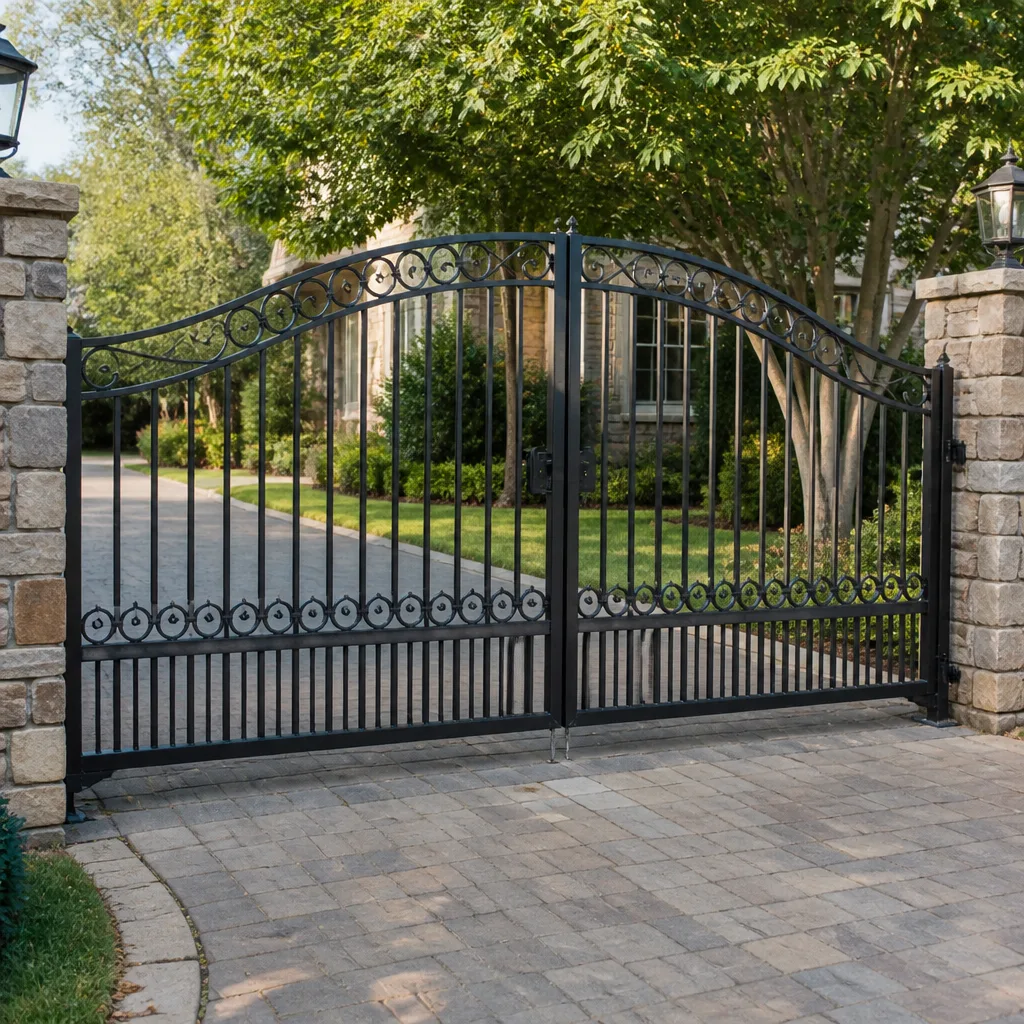 Wrought iron
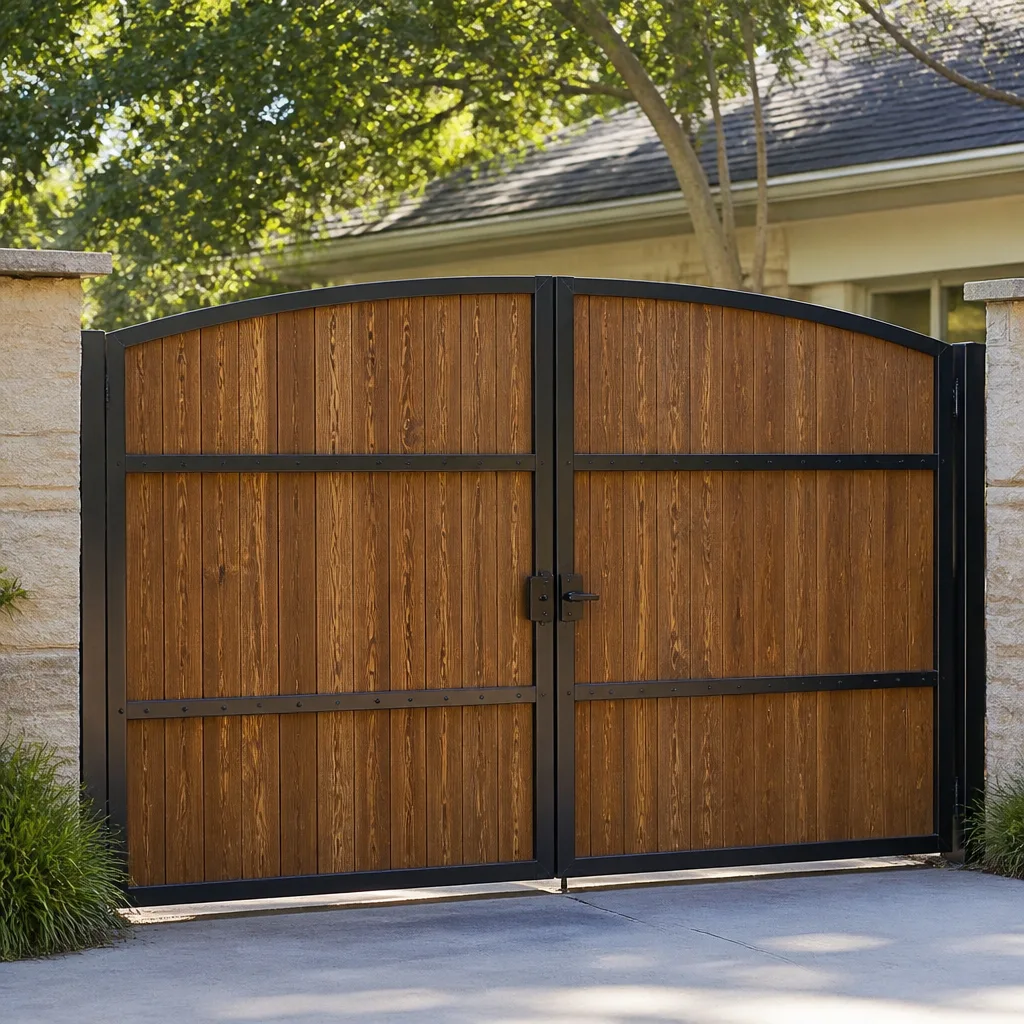 Wood & steel frame
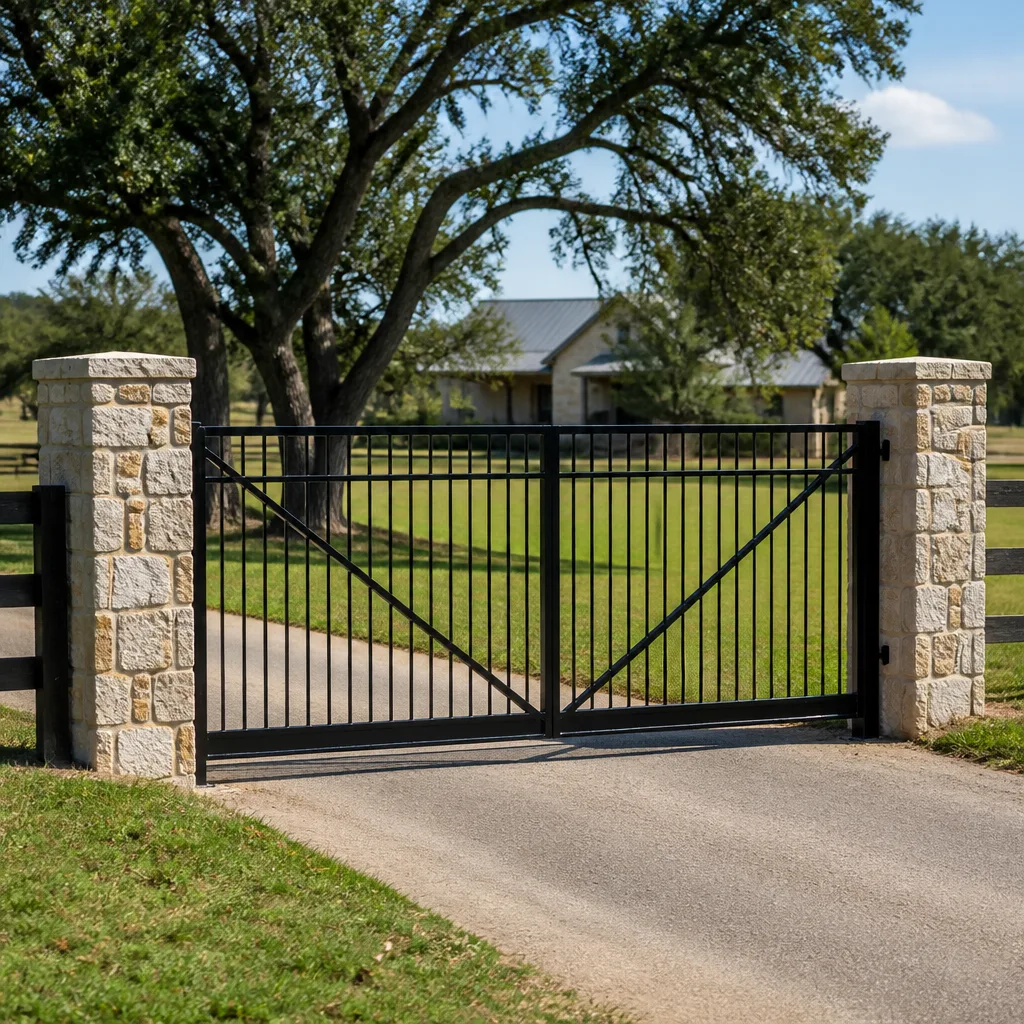 Farm & ranch
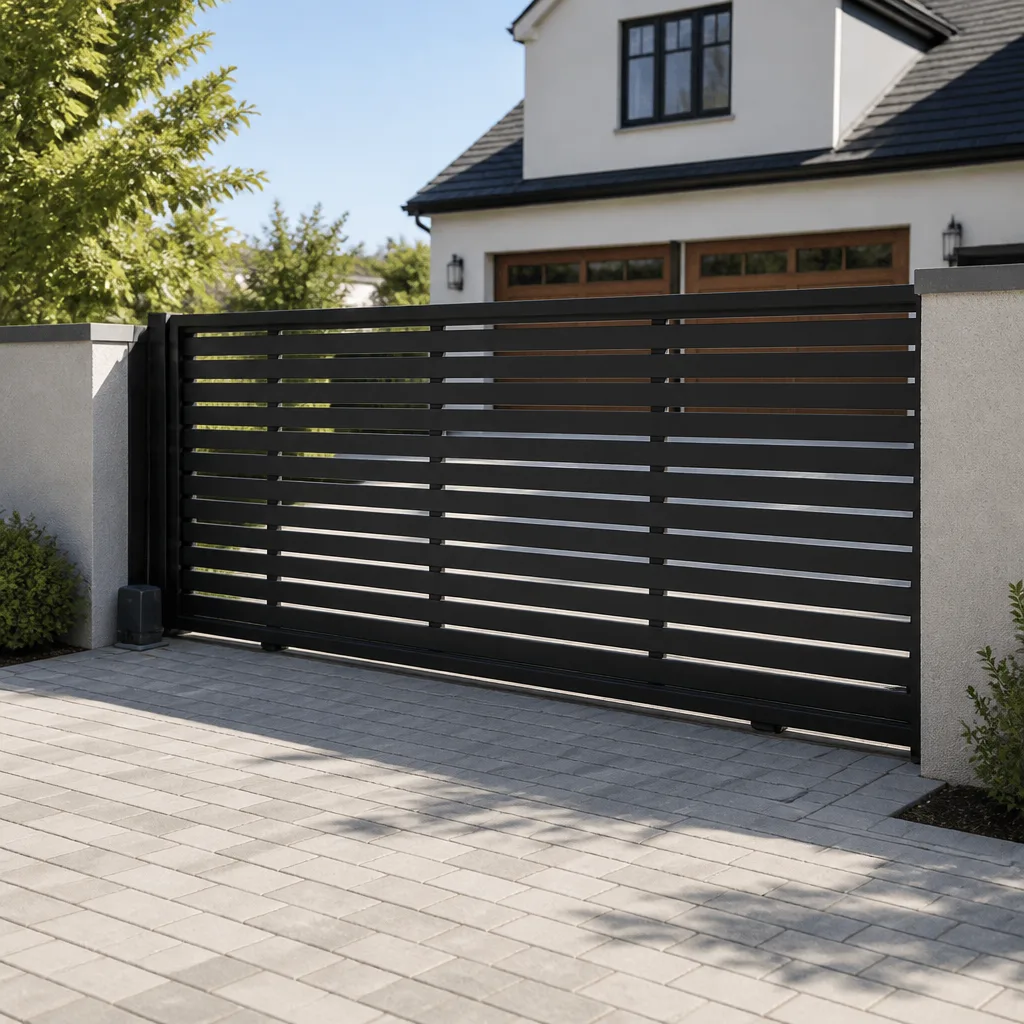 Sliding driveway gates
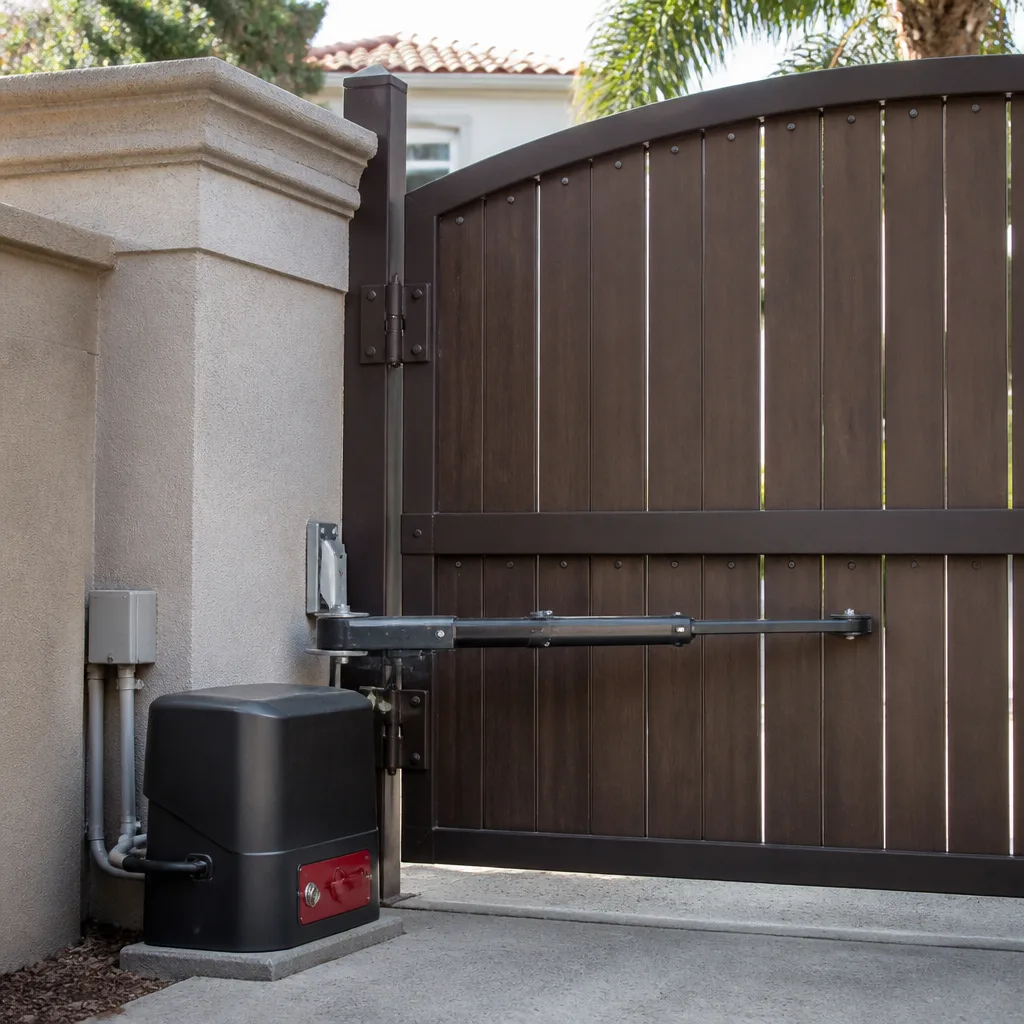 LiftMaster operators
Free on-site gate assessment - hinges, posts, and your LiftMaster or Nice gate operator checked before anything is quoted
The assessment is free and the quote is the invoice.
Get your free estimateThe Complete Guide to Gate Repair in Austin
Most Austin gate failures aren’t hardware failures at all – they’re foundation failures. The same expansive clay that cracks your driveway shifts your gate posts by fractions of an inch every season, and that invisible movement is what burns out motors and warps frames long before their time. This guide explains the failure patterns we see across Austin, from Steiner Ranch to Mueller to Circle C, and gives you the vocabulary to describe a problem accurately before anyone shows up. You’ll learn which repairs treat symptoms, which fix actual causes, and what a written price guarantee should actually say. By the end, you’ll know more about how your gate actually works than most repair estimates will ever tell you.
Quick Answer
Gate repair in Austin typically costs $185 to $650 depending on whether the problem is mechanical, electrical, or foundation-related, and the most common cause of recurring gate failure in the Austin area is post movement caused by expansive clay soil. A written estimate with a line-item breakdown should be standard, and any repair that doesn’t address post alignment on a misaligned gate is a temporary fix. Warden Gate Repair Austin provides written pricing before work begins and backs every Gate Repair with a 365-day guarantee.
Styles & brands we work with
Table of Contents
- How Austin’s Soil Breaks Gates
- Gate Motor Failure in Austin Heat: What Actually Happens
- The HOA Permit Trap in Austin’s Master-Planned Communities
- Reading a Gate Repair Estimate Line by Line
- What a Written Price Guarantee Should Actually Say
- Brand-Specific Failure Patterns: LiftMaster, Mighty Mule, Viking, and Elite
- How to Diagnose Your Gate Before You Call
- Common Mistakes to Avoid
- When to Call a Professional
- Frequently Asked Questions
- The Bottom Line
How Austin’s Soil Breaks Gates
Austin sits on two distinct soil regions that behave very differently under your gate. The western half of the city and much of the Hill Country southwest sits on limestone bedrock with a thin soil layer – stable, predictable, and mostly kind to fence and gate posts. The eastern and central parts of Austin, including most of the city’s established neighborhoods, sit on the Blackland Prairie: a band of expansive clay that shrinks during dry summers and swells during wet springs. This shrink-swell cycle moves soil vertically by anywhere from one to four inches per year.
A gate post embedded in this soil doesn’t lean suddenly. It tilts a fraction of a degree every season. After three or four years, accumulated movement becomes visible: the gate drags against the ground, the latch no longer lines up, or the frame binds mid-swing. What looks like a mechanical failure is a geometry problem.
In our experience across Austin neighborhoods like Allandale, Crestview, and Rosedale, we see two distinct failure patterns tied directly to soil type. In clay-dominant areas, the gate post itself moves while the operator bracket stays bolted to it – meaning the whole assembly shifts together and the gate scrapes or misses the catch. In limestone areas farther west, the post generally stays put and the mechanical wear is more conventional: hinge wear, roller fatigue, or operator failure from age and exposure.
There are three legitimate fixes for the clay-soil problem:
- Symptom repair: adjusting the operator bracket, re-angling the hinges, or shimming the latch. This restores function for six to eighteen months, then the underlying movement reasserts itself.
- Structural repair: resetting the post in a deeper footing with proper drainage and concrete that extends below the shrink-swell layer. In central Austin that often means a three-foot-deep footing rather than the eighteen-inch standard most builders used fifteen years ago.
- Intermediate stabilization: adding a mid-span ground support wheel on a sliding gate, or a tensioned cable kit on a swinging gate, which compensates for minor seasonal movement without resetting the foundation.
A written estimate should identify which category the proposed work falls into. If the estimate doesn’t mention post movement at all and your gate is visibly out of alignment, the repair is a symptom fix, not a cause fix. Sometimes a symptom fix is genuinely the right call on a fifteen-year-old gate that’s due for replacement. You should just know which one you’re paying for.
Gate Motor Failure in Austin Heat: What Actually Happens
Gate motors in Austin fail differently than gate motors in Houston or Dallas. Heat is the obvious stressor, but humidity and sun exposure are what actually kill electronics. An enclosed operator box mounted on a west-facing gate in Austin bakes in direct afternoon sun for four or five months a year. Internal temperatures reach 120 to 140 degrees Fahrenheit even when the ambient air is only 95. Capacitors degrade, circuit board solder joints soften and crack, and the internal battery on solar-assisted openers dies earlier than the manufacturer’s stated five-to-seven-year lifespan.
Humidity is the second killer. Austin’s summer humidity sits in the 60 to 80 percent range most mornings, and that moisture condenses inside any operator housing that isn’t properly sealed. We’ve opened operator boxes in Austin neighborhoods like Tarrytown and Barton Hills and found standing condensation on the control board. That corrosion causes intermittent failures – the gate works sometimes, then stops, then works again – which are exactly the failures that are hardest to diagnose over the phone.
Brand differences matter more in this climate than manufacturers admit:
- LiftMaster operators are built for volume and tolerate heat reasonably well, but their control boards are sensitive to power surges – which matters in Austin, where thunderstorms and grid fluctuations are routine. A surge-damaged LiftMaster board usually fails by losing its limit settings, so the gate opens halfway and stops.
- Mighty Mule is an entry-level DIY brand, and its failure pattern in Austin is predictable: the plastic drive gears strip under repeated thermal expansion, typically inside two to three summers on a west-facing installation. The motor still runs; the gate doesn’t move.
- Viking builds heavier-duty operators, and their failure pattern here is different: the solenoid and limit switch assemblies wear out faster in dusty conditions. Austin’s stretch of dry summer weeks followed by construction activity in growth corridors means dust infiltration is a real factor.
- Elite operators are common in Austin’s higher-end residential and small commercial installations. They’re generally reliable, but their circuit boards are proprietary and expensive to replace. A failed Elite board on a swing gate often costs more than the labor, which is a pricing fact worth knowing before you approve work.
We service all four brands and carry repair parts for them. Gate motor repair in Austin is its own discipline, and in most cases, a failed motor on a gate under ten years old can be repaired rather than replaced – if the diagnosis identifies the actual failed component instead of defaulting to a full operator swap.
The HOA Permit Trap in Austin’s Master-Planned Communities
Austin has one of the highest concentrations of HOA-governed neighborhoods in Texas, and the rules are not uniform. Steiner Ranch, Teravista, Avery Ranch, and Circle C each have architectural control committees with different notification requirements, review timelines, and gate-specific restrictions. Homeowners often discover this mid-project: the technician arrives, the old gate is already off its hinges, and a neighbor files a complaint about an unapproved modification.
The sequence in most Austin metro HOAs is counterintuitive. HOA approval comes before city permitting, not after. For a gate replacement or a significant structural repair – typically anything involving post resetting or operator relocation – the architectural committee reviews the aesthetic details first: material, color, height, and placement. Once the HOA signs off, the city permit becomes relevant for any work involving concrete footings or electrical runs.
What most repair estimates won’t tell you is who is responsible for what:
- No structural change, no panel replacement: most HOAs don’t require approval at all. This covers most motor swaps, circuit board replacements, hinge repairs, and battery replacements.
- Panel replacement with same material and color: many HOAs require a notice and short review, but approval is usually granted within seven to ten days. Steiner Ranch and Teravista generally follow this path.
- Full gate replacement with design change: this routinely takes two to four weeks of HOA review, and some HOAs restrict material or style. Black wrought iron is nearly always permitted; wood composite frequently draws restrictions in communities with uniform aesthetic standards.
- Post resetting or concrete work: city permitting may kick in here, and the permit is the responsibility of the contractor, not the homeowner. A written estimate should state who is pulling the permit and whether the permit fee is included or separate.
The trap most Austin homeowners fall into is signing a repair contract before confirming HOA requirements, then facing a cancellation fee or a nonrefundable order when the approval drags on. A legitimate gate repair company in the Austin metro area will either know the local HOA patterns or ask about them before work begins. If a company promises a same-day structural repair in a community with known HOA review timelines, the promise is not credible.
Reading a Gate Repair Estimate Line by Line
Most gate repair estimates are written to be skimmed, not understood. Vague language hides margin and creates room for surprise add-ons. A line-item estimate is the minimum standard for work over $300. Here is what each line should actually tell you:
- Diagnosis fee: many companies charge $75 to $150 to come out and diagnose, and some credit that fee toward the repair if you approve the work. If the estimate doesn’t state the diagnosis fee treatment, assume it is not credited.
- Parts: a legitimate line item names the part by brand and part number, not by function. “Operator switch” is vague. “LiftMaster K74-30768 limit switch assembly” is specific. Vague part language is the single strongest predictor of an upsell attempt when the ‘right’ part is suddenly more expensive.
- Labor: labor should be quoted as a flat amount per task, not as an hourly rate with “estimated hours.” Open-ended hours are how a $400 repair becomes an $800 one.
- Trip or travel charge: in the Austin metro, a trip charge beyond a diagnosis fee is rare for any company based inside the city. If the estimate includes both, ask why.
- Permit line: if the job involves concrete or electrical work, a permit fee line is legitimate. If it appears without explanation, ask what permit it covers and who obtains it.
- “Shop supplies” or “miscellaneous”: this is the line that hides profit above the stated labor rate. There is no legitimate shop supply cost on a gate repair. Cables, brackets, and bolts are parts and should be itemized as parts.
When you’re comparing Gate Repair Cost Breakdown estimates in Austin, the useful comparison is not total price. It’s whether the estimate tells you what will be done, with what parts, by whom, and under what guarantee. Cheap estimates are cheap because they’re vague. If an estimate won’t survive line-by-line scrutiny, the price is not the discount it appears to be.
What a Written Price Guarantee Should Actually Say
“Free estimate” is the most common phrase in home service marketing and the most frequently hollow. In gate repair, a free estimate is usually a diagnosis pitch dressed up as generosity. The real protection is a written price guarantee, and the language matters more than the presence of the guarantee itself.
Here are the three loopholes that make most written guarantees worthless:
- “Estimate valid at time of inspection.” This phrasing allows the price to change the moment any new information surfaces – including information the technician knew at the inspection. A real guarantee locks the price for the described scope of work.
- “Additional work may require a change order.” Technically true on every job in every trade. The problem is when the change order follows a vague initial scope. If the initial scope is itemized and specific, a change order should be rare. If the initial scope is general, expect one.
- “Guaranteed against defects in workmanship only.” This is the narrowest possible guarantee. It covers errors the technician made, not failures of the repair itself. A meaningful guarantee covers both workmanship and the performance of the parts installed.
Warden Gate Repair Austin operates differently. Every estimate is written, itemized, and delivered before any work begins – no exceptions. The price you approve is the price you pay. If a repair fails within 365 days, the return visit is free under our 365-Day Done Right Promise. That’s the plainest version of a guarantee we know how to write, and it’s the one we actually stand behind.
See the difference
 Before
 After
After Before
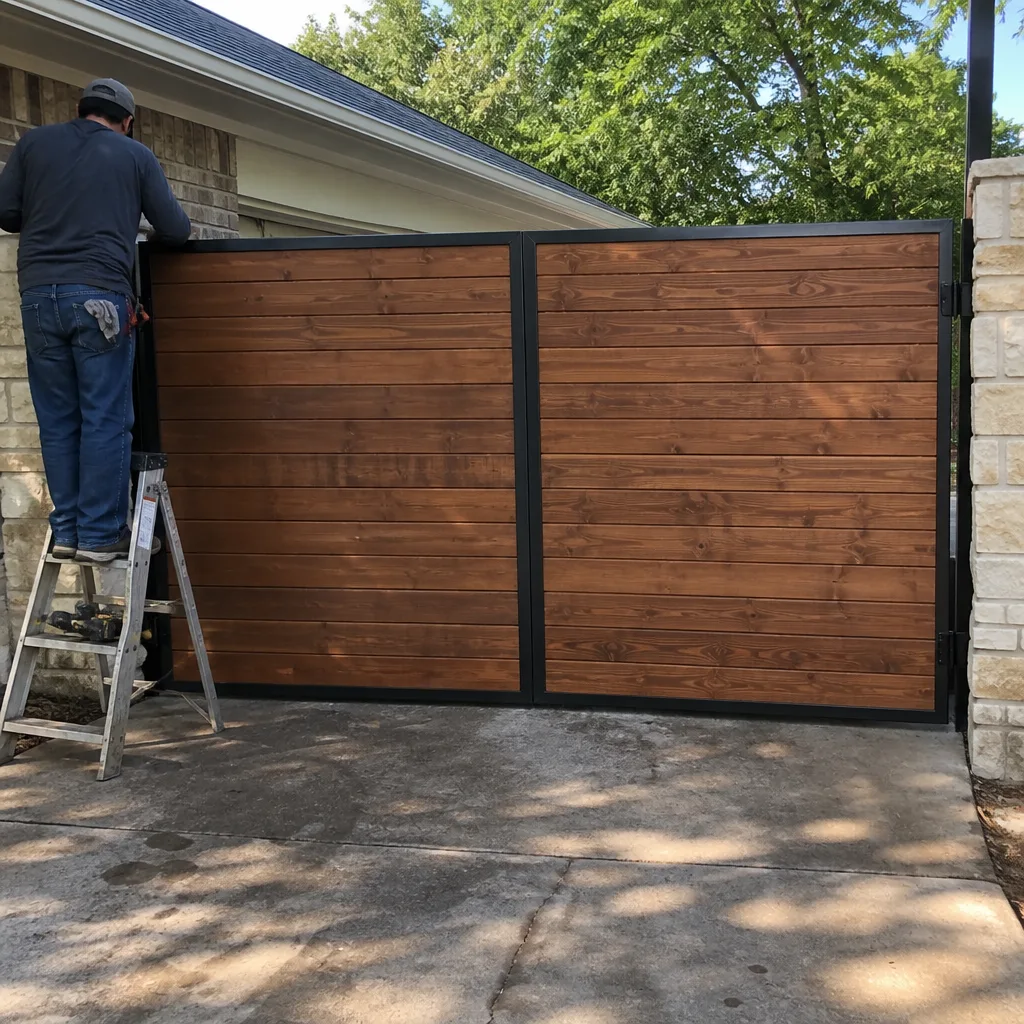 After
After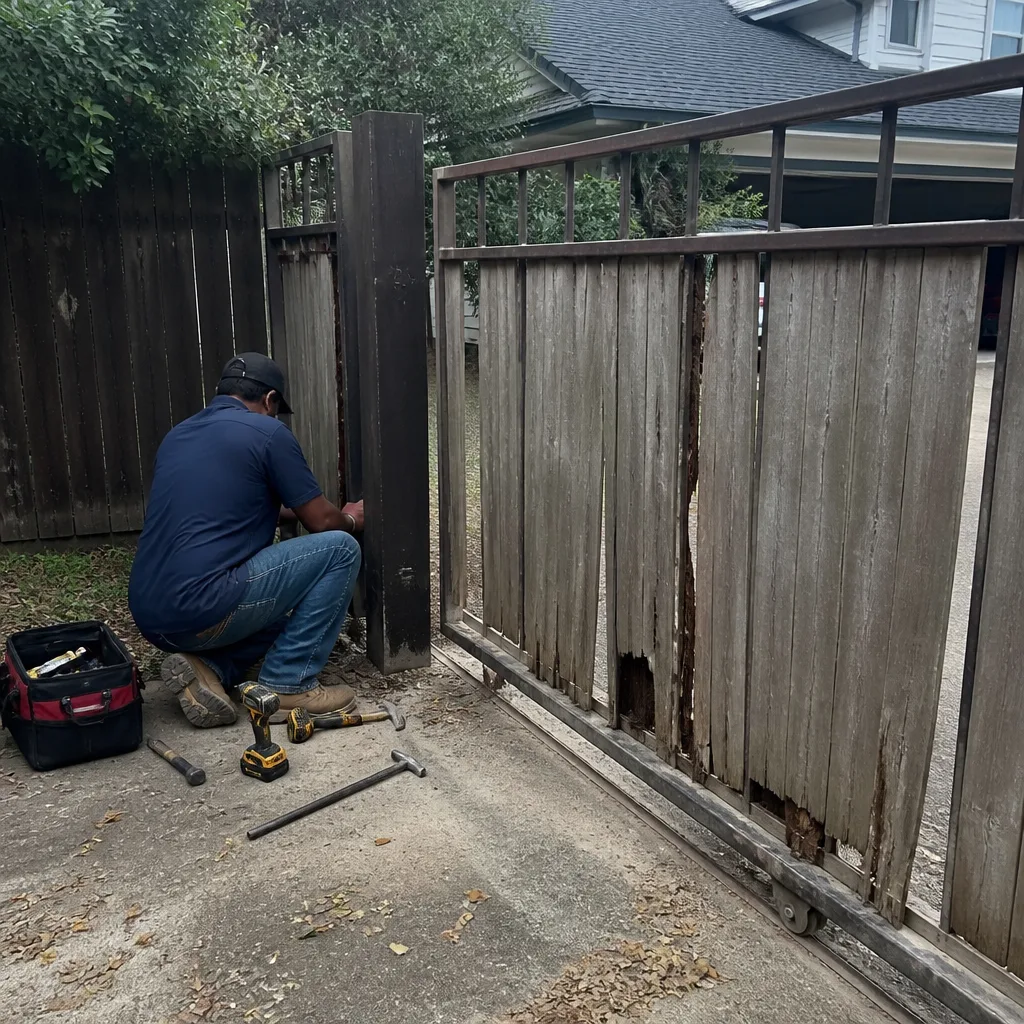 Before
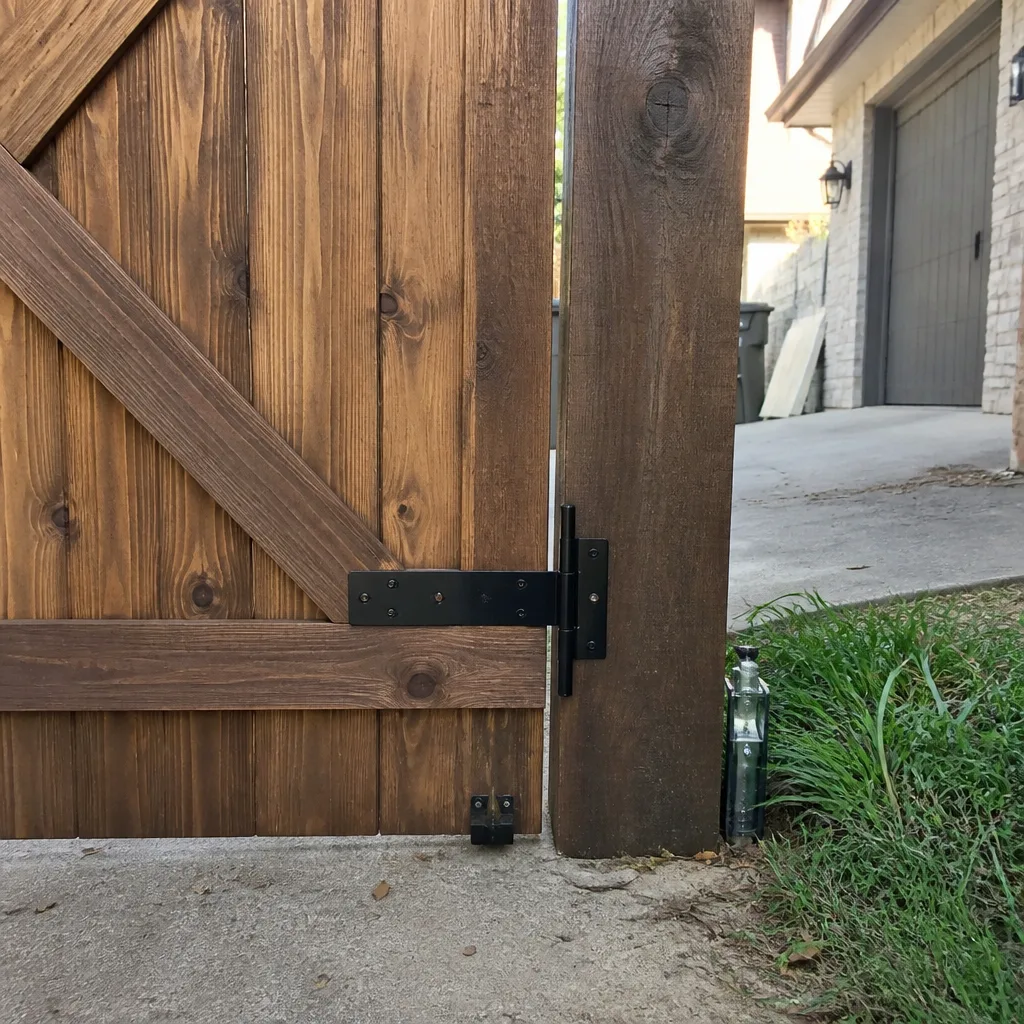 After
AfterBrand-Specific Failure Patterns: LiftMaster, Mighty Mule, Viking, and Elite
Every gate operator brand has a personality. In Austin’s specific climate conditions, those personalities produce predictable failure patterns that let a trained technician diagnose faster and repair more precisely. Here is what we’ve observed after nearly two decades of servicing these brands across Austin.
LiftMaster: Electrical Sensitivity and the Surge Problem
LiftMaster dominates the installed base in Austin’s subdivisions because most production builders spec their operators as a default. They’re competent machines, but their control boards are more sensitive to power fluctuations than any other brand we carry. Austin’s storm cycles – particularly the spring thunderstorm season – produce frequent utility fluctuations, and LiftMaster boards are typically the first casualty. The failure signature is a gate that loses its programming or its limit settings after a storm.
The repair is usually a board replacement with a surge protector added to the power supply line. That surge protector is the difference between a one-time repair and a recurring problem. If a LiftMaster quote doesn’t include surge protection as part of a board replacement, ask why.
Mighty Mule: The Thermal Expansion Problem
Mighty Mule markets directly to DIY vs Professional homeowners, and the installed base across Austin reflects that. These operators are genuinely affordable and genuinely limited. The plastic drive assembly inside a Mighty Mule expands and contracts with ambient temperature, and after two to three Austin summers on a west-facing gate, the gear teeth begin to strip. The motor runs, whines, and stops. The gate doesn’t move.
At that point the repair decision is genuinely economic: a replacement gear assembly costs about a third of a new operator, but the underlying thermal vulnerability remains. We present both options to Austin homeowners and let them decide. For a gate under light use in a shaded north-facing location, the repair makes sense. For a heavy gate in full afternoon sun, replacement with a more robust operator is the better long-term recommendation.
Viking: Dust and Limit Switch Wear
Viking builds the heaviest-duty operator of the major residential brands, and in Austin’s dusty conditions that strength works against it in one specific way. The mechanical limit switches that tell a Viking operator when to stop are exposed to the elements more than on sealed units. Austin’s combination of dry summer dust and construction dust in growth corridors like Leander, Buda, and Hutto accelerates wear on those switches.
The failure presents as a gate that overshoots its normal travel or stops midway. The repair is usually a limit switch assembly replacement, which is a fraction of the cost of a full operator. This is the damage pattern a less experienced technician writes off as ‘needs a new operator.’ It doesn’t. It needs a $40 to $80 limit switch assembly and an hour of labor.
Elite: The Proprietary Board Conundrum
Elite operators – common on Austin’s higher-end residential gates and light commercial installations in places like Westlake and Rollingwood – are well-engineered machines. Their vulnerability in this market is economic rather than mechanical. Elite control boards are proprietary, meaning only Elite boards work in Elite operators. When a board fails out of warranty, the replacement part can cost $400 to $700 before labor.
That pricing reality makes preventive maintenance worthwhile. A $150 annual inspection that catches a corroding terminal block or a degrading capacitor is far cheaper than a $700 board replacement. In our experience, Elite operators that receive annual service in Austin conditions routinely reach ten to twelve years without a board failure. Ones that don’t frequently fail in five to seven.
How to Diagnose Your Gate Before You Call
The most useful thing you can do before calling for gate repair in Austin is narrow down the problem. The more specific your description on the phone, the more likely the right parts arrive on the first visit. Here is a five-step diagnostic sequence that takes ten minutes:
- Observe what still works. Does the gate move at all? Does the motor hum? Does the remote trigger any response – even a click? Write down exactly what happens when you press the button.
- Check the power source. If the operator is on a dedicated circuit breaker, confirm the breaker hasn’t tripped. If the gate has a battery backup or solar panel, note whether the gate works on battery but not mains power, or vice versa.
- Look at the gate itself, not the motor. Disconnect the operator (most have a manual release lever) and try moving the gate by hand. If it’s heavy, dragging, or binding, the problem is mechanical – hinges, rollers, post movement – not electrical.
- Check alignment. Close the gate fully and look at the gap between the gate and the latch post. If the gap is uneven – tight at the top, wide at the bottom – you have post lean or hinge wear. This is the most common root cause of Austin gate failures.
- Note any new sounds. A grinding noise is usually a gear or chain problem. A clicking sound that repeats without movement usually points to a failed capacitor or a stripped gear. A silent operator with power at the outlet usually means a control board issue.
With this information in hand, the phone conversation changes from “my gate doesn’t work” to “my LiftMaster hums but the gate won’t move, and the gate swings freely by hand when I release the operator.” That description saves a diagnostic visit and often gets the repair done in one trip.
Common Mistakes to Avoid
- Ignoring post movement for more than one season. Every month a misaligned gate operates, it adds stress to the motor, hinges, and frame. What starts as a $200 post realignment becomes a $900 motor replacement if left alone in Austin’s shifting clay.
- Approving work without a written, itemized estimate. Verbal estimates protect the contractor, not you. In the Austin market, any legitimate gate company can provide a written price before work starts.
- Replacing the operator without diagnosing the gate itself. A new motor on a binding gate is a future warranty claim. The binding problem will destroy the new motor the same way it destroyed the old one.
- Trusting a “free estimate” that doesn’t include diagnosis. Free estimates often mean the diagnosis itself is the product being sold. You’ll get a vague verbal range at first contact and a firmer, higher price once the technician is on your property.
- Forgetting HOA notification on structural repairs in governed communities. Austin’s HOA density is among the highest in Texas. A post reset or panel replacement in Steiner Ranch or Circle C without approval can result in a demand letter and a forced reversal.
- Delaying spring maintenance until the rainy season. Austin’s spring rain is when most gate failures surface, because saturated soil swells and gates that were barely aligned in February are dragging by April. A maintenance check in late winter prevents most of the flood of repair calls we field each March and April.
- Shopping on total price alone. The cheapest Austin gate repair quote is often the most expensive one, because vague scopes become change orders. Compare the specificity of the estimate, not just the bottom line.
When to Call a Professional
Some gate problems are worth attempting yourself: a remote battery, a tripped breaker, an obstruction in the track. Most are not. Call a professional when the gate drags or binds, when the operator makes noise but doesn’t move the gate, when the gate moves in one direction but not the other, when you see visible post lean, or when the failure is intermittent – those are the hardest to diagnose and the easiest to make worse with guesswork.
We’ve rebuilt enough DIY attempts over the years to say this plainly: working on an electric gate motor without disconnecting power is dangerous, and working on tensioned hinges and springs without proper tools and training is how people get hurt. Warden Gate Repair Austin offers free estimates throughout the Austin area – call (361) 268-6253 and you’ll get a real conversation with a human being, a written price, and the name and photo of the technician who will arrive at your door.
Frequently Asked Questions
Most gate repairs in Austin land between $185 and $650 depending on the failed component, the brand, and whether post realignment is involved. Simple limit switch replacements run $185 to $250, operator board replacements $300 to $600, and post resets $400 to $900 depending on footing depth and HOA constraints. Every quote should be itemized and written before work begins – call (361) 268-6253 for a free estimate from Warden Gate Repair Austin.
We typically can, depending on the nature of the failure and current call volume. We field emergency calls across Austin for gates that won’t open, gates that won’t close, and security situations where property can’t be secured. For non-emergency repairs, we schedule within one to three business days. Call (361) 268-6253 and you’ll speak to a live person who can give you a realistic same-day assessment.
A full installation includes removal of the existing gate and operator, post or footing work as needed, the new gate panel, a matched operator sized to the gate’s weight and duty cycle, safety edges or photoelectric sensors where required, and programming of remotes and keypads. The written estimate should separate each of these line items so you can see exactly what your money buys – that is how Warden Gate Repair Austin structures every quote.
Yes. Electrical power runs from the nearest service point to the operator location are part of a full installation, as are safety edges on sliding gates and photo eye sensors on swinging gates. These are not optional add-ons – they are safety requirements under most Austin area code jurisdictions and should be standard on any professional installation, including every quote from our electric gate repair service.
Intermittent gate failures in Austin are most commonly caused by three things: corrosion or moisture inside the operator housing from our humidity, a failing capacitor that works while cool and fails when hot, or a loose or corroded wire connection in the operator or at the keypad. The failure will get more frequent over time, not less. These are the hardest failures to diagnose remotely, which is why our technicians arrive with diagnostic equipment and a stocked vehicle for the most common Austin failure patterns.
In our experience, LiftMaster and Viking operators hold up best in Austin conditions, but no brand is failure-proof. LiftMaster’s installed base is the largest, so we see the most of any given failure. Viking’s mechanical components are the most durable, but their limit switches need more frequent service in dusty conditions. The single most important factor in operator lifespan in this climate is not brand – it’s gate alignment and annual maintenance. A well-maintained Mighty Mule outlasts a neglected Elite every time.
Not for most repairs. Motor swaps, board replacements, hinge work, and limit switch repairs are considered maintenance under most Austin HOA covenants and require no approval. Panel replacement, post resetting, and any visible material or color change typically require architectural committee sign-off, which can take one to four weeks in master-planned communities like Steiner Ranch, Avery Ranch, and Teravista. Confirm your community’s specific rule before structural work is scheduled.
The Bottom Line
Your gate works hard in Austin’s climate, and most failures are the accumulated result of soil movement, thermal stress, and deferred maintenance – not random breakdowns. For more guides & resources, explore our blog. The right repair treats the actual cause, not just the symptom. A meaningful estimate is itemized, specific, and written before work starts. And the guarantee matters as much as the repair itself.
Warden Gate Repair Austin has been serving Austin since 2008. We send you the technician’s name and photo before arrival under the Threshold Standard, we quote a written price before any work begins, and we guarantee every repair with the 365-Day Done Right Promise. If it fails within a year, the second visit is free. For more about our services, visit the Warden Gate Repair Austin home page, or call us directly at (361) 268-6253 for a free estimate.
Written by Cole Rafferty, Owner at Warden Gate Repair Austin, serving Austin since 2008.